The Last Sacrifice
by Hope Madden
Documentarian Rupert Russell has a pretty wild tale to tell, one set in an isolated British community where outsiders aren’t wanted, information is hard to come by, and something sinister waits in the fields.
And if that sounds like every British folk horror film from The Wicker Man in 1973 to Kill List in 2011, there’s a reason. Russell tracks the birth of British folk horror cinema to one specific moment and place in time: Cotswold District, Gloucestershire, England, Valentine’s Day, 1945.
On that day in that hamlet—an isolated farming community of about 200 people—Charles Walton was found dead, a pitchfork in his face and throat, a billhook in his neck. The murder shook the nation, its description taking on wild details over the retellings: a cross carved in his chest, dead frogs all around him. The crime so enthralled England that its most prized Scotland Yard detective, Robert Fabian, came to Cotswold to investigate.
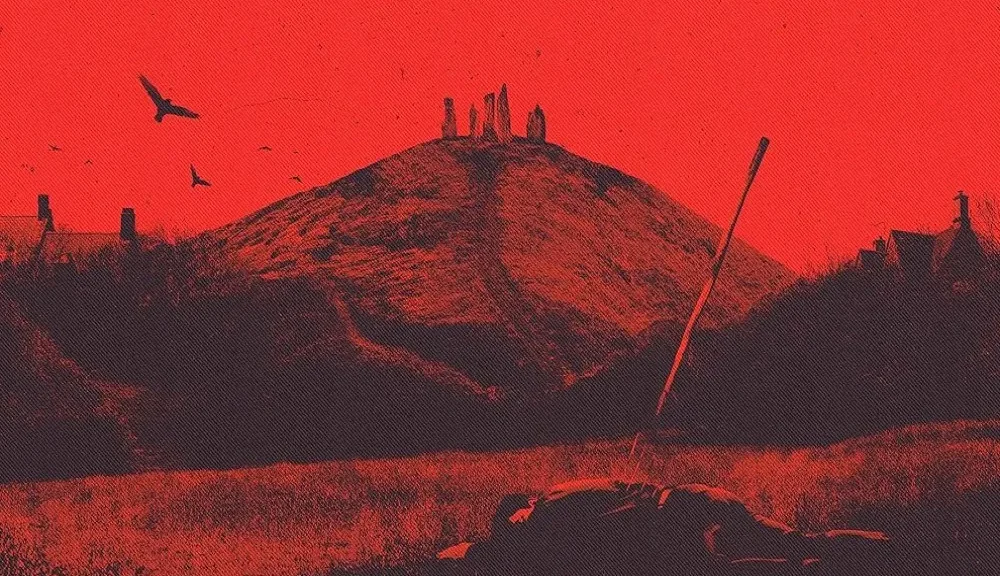
What he found was a community unwilling to cooperate in the investigation, and the Rollright Stones, enormous ancient stones said to be what remains of an Iron Age King and his soldiers after a witch’s curse.
This is all fascinating enough, but Russell goes on to explore the genuine British witchcraft phenomenon of the Sixties and Seventies, and even brings in a Teletubby. What’s wildest about this documentary is the way that the old films—including the campiest Hammer greats The Devil Rides Out, The Witches, and Dracula A.D. 1972—are based directly from documentary footage of official witch rituals of the time.
The campier and more ridiculous the scene, the more exactly it recreates rituals celebrated by Alex Sanders, the era’s self-proclaimed King of the Witches.
Except that, of course, Sanders and his followers were harmless, and Hammer’s witches rarely were. But Sanders’s incredible popularity sparked new interest in the Cotswold murder and a whole, very British film genre was born.
The Last Sacrifice is sometimes clunky in its true crime format. It’s trying too hard to be scary. The approach doesn’t always suit the material, because the wild cinematic crossover with nonfiction is exponentially more interesting, and no crime was committed there. The information is revelatory for horror film fanatics, jaw-dropping, even. And certain details are downright funny.
Russell’s sometimes wobbly approach to the doc is hardly a reason to skip it. If you have any interest in British folk horror, The Last Sacrifice is a fascinating must-watch. (Give yourself the gift of a double feature, with Kier-La Janisse’s 2021 doc Woodlands Dark and Days Bewitched, also on Shudder.)

