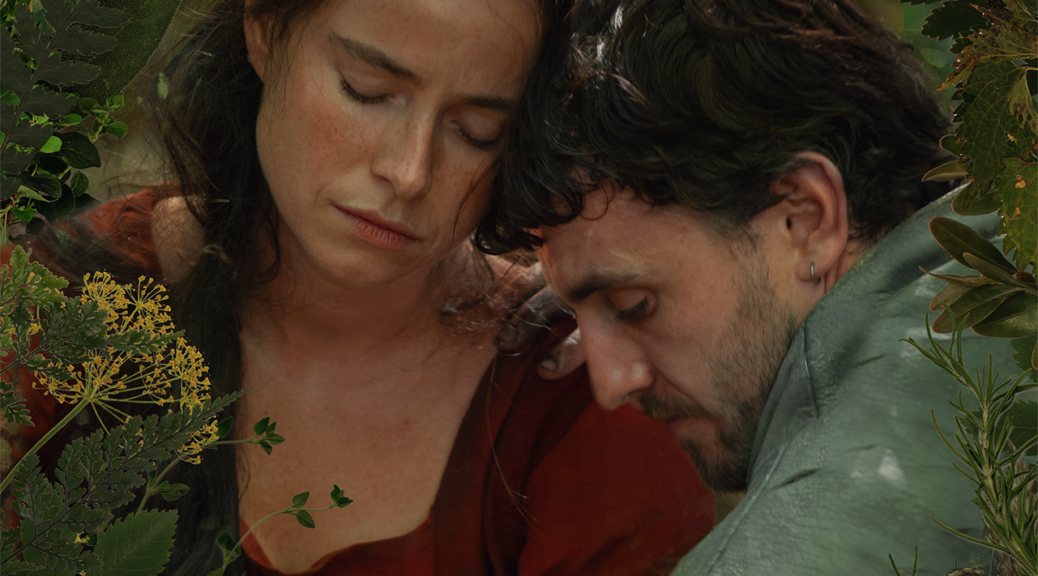
Hamnet
by Hope Madden
It’s been five years since Chloé Zhao took home two Oscars, one for directing and one for adapting the screenplay for Nomadland. She returns to form in both respects with Hamnet, the cinematic adaptation of Maggie O’Farrell’s novel that imagines the way grief may have shaped Shakespeare’s greatest tragedy.
Zhao’s film opens stunningly on Jessie Buckley, nestled womblike among the roots of a massive tree, her face and hands dirty, her hair tangled with leaves. Buckley is Agnes, believed by those in town to be the daughter of a forest witch. Agnes comes from what is.
Will (Paul Mescal) imagines what can be. The hyper real poetry of Zhao’s camera perfectly articulates their yin/yang balance.
It’s with Will that we first see Agnes’s nurturing side applied to humanity rather than the wild. It’s a trait that will become the backbone of their story. Her love is powerful, messy, and unforgiving, and Buckley’s more than up to the task. Her performance, as is so often the case, feels dangerous and uncensored. And gazing adoringly at her, inspired and nurtured, is Will. If there is a better face in cinema than Mescal’s for earnest yet doomed longing, I don’t know whose it could be.
The young cast more than keeps pace. Jacobi Jupe is particularly amazing and utterly heartbreaking as Will and Agnes’s boy, Hamnet. (His older brother Noah Jupe also impresses later in the film as the actor portraying the great Dane in the first ever stage production.)
By the time the most famous lines in theatre are uttered, it takes restraint and rawness. The slightest hint of artifice and the previous ninety minutes are ruined, the film a gimmick. But Zhao never skirts artifice, not even when she makes a Marvel movie, and Mescal delivers lines we know by heart as if they were freshly pulled from an open wound.
Zhao has crafted, aided by magnificent performances and hauntingly stunning cinematography from Lukasz Zal (The Zone of Interest, Cold War), a film that is shattering in its articulation that it is the depth of love that deepens and amplifies the pain of grief.
People make movies about grief all the time. We can expect one every Oscar season. But what Chloé Zhao does with Hamnet is ask us to experience that grief, not just witness it, and in experiencing it we understand the power and vital importance of art.

